Raw, Pure or Unfiltered Honey: What the Labels Really Mean
The friendliest words on a honey jar are the ones the law leaves alone. “Raw”, “pure”, “unfiltered” and “natural” don’t appear anywhere in the honey regulations for England and Scotland. The plainer words do: “honey” itself, “filtered honey”, “baker’s honey”, the country of origin, and the name of a flower or a place. Those are the words with rules behind them, so they’re the ones worth reading first.
We keep over 500 hives across Scotland. We call our honey “raw”, and our gift sets use the word “pure”, so this is partly us explaining our own wording. The table below decodes each word in a line, and our own honey comes at the end as a worked example. If you’d like raw honey itself in depth, how it’s made and what it looks like in the jar, our guide to what raw honey is covers that.
Honey label words decoded
“Honey law” here means the Honey (England) Regulations 2015 and the Honey (Scotland) Regulations 2015, which set out the same main rules on these points. Organic labelling sits under separate rules for Great Britain.
| Word on the label | Legally defined? | What it tells you | What to check instead |
|---|---|---|---|
| Honey | Yes | Made by honeybees, with nothing added except other honey | Country of origin and who made it |
| Pure, 100% pure | No | Nothing the word “honey” doesn’t already promise | Origin and how it was made |
| Raw | No | The producer’s claim of minimal processing; there’s no legal test | How it was made and who made it |
| Unfiltered | No | The producer’s claim that it hasn’t been finely filtered; it may still have been strained | How the wax was taken out |
| Filtered honey | Yes, a legal name | Filtered in a way that removed a significant amount of pollen | No flower, place or quality claim is allowed on it |
| Natural | No | Nothing specific; guidance allows it if it isn’t misleading | Origin and how it was made |
| Organic | Yes, under GB organic rules | Certified by an approved organic control body | A GB-ORG code on the label |
| Country of origin, or “blend of honeys from more than one country” | Yes | Where it was harvested, or that it’s a blend | Whether one country is named, or several |
| Flower or place name (heather, Scottish) | Yes | Wholly or mainly from that flower; entirely from that place | Who made it |
| Baker’s honey | Yes, a legal name | Honey for cooking or use as an ingredient; the heating limit doesn’t apply | “Intended for cooking only” near the name |
Pure honey: reassurance, not information
Anything sold as honey in England or Scotland has to be just that. The regulations say nothing may be added to it: no food ingredient, no additive, and nothing else except other honey. So “pure honey” or “100% pure honey” repeats a promise the word “honey” has already made by law.
That doesn’t make the word dishonest. The Food Standards Agency’s guidance on label terms, which dates from 2008 and is informal rather than binding, suggests “pure” should generally be kept for single-ingredient foods with nothing added, and honey fits. It just doesn’t tell you anything new. A jar of “pure honey” could come from one apiary or be a blend from several countries, and the word gives you no clue which.
Raw honey: an everyday word, not a legal one
“Raw” isn’t defined in the honey regulations for England or Scotland. The closest thing to an official reading comes from a 2024 case. Waltham Forest council in London served a company with a notice to take “raw” off its honey labels. The company appealed, and in Odysea Ltd v London Borough of Waltham Forest the First-tier Tribunal cancelled the notice. It found that shoppers understand “raw” in its everyday sense of unprocessed, and that the word accurately described honey that hadn’t been processed, including by heating. It also declined to set a lower limit for how much processing “raw” allows.
Keep that in proportion. It’s one tribunal decision about one company’s labels. It doesn’t make “raw” a legal term, and it doesn’t mean every jar marked “raw” has passed some test.
What the law does set is a limit on heating. The regulations already restrict how far any honey, other than baker’s honey, can be heated. “Raw” is a producer telling you they’ve kept processing to a minimum on top of that. How far they’ve gone is up to them, which is why how the honey was made, and who made it, tells you more than the word.
Unfiltered, strained and “filtered honey”
This is where honey labels get most confusing, and where the law is at its clearest.
Spinning or pressing honey out of the comb brings bits of wax with it, and those need taking out before the honey is jarred. Trading Standards guidance describes filtering honey to remove unwanted matter as common practice, and it doesn’t need any special name on the label.
Fine filtering is a different thing. Under the regulations, “filtered honey” is honey that has had foreign matter removed in a way that takes out a significant amount of its pollen. Honey treated like that must be sold under the name “filtered honey”, and it can’t make claims about a flower, a region or its quality. For every other honey, the rules say no pollen or other part of the honey may be taken out, except where that can’t be avoided while removing foreign matter.
Put those rules together and you get a handy reading rule. A jar sold simply as “honey”, rather than “filtered honey”, shouldn’t have had its pollen significantly filtered out. And a jar of filtered honey can never call itself heather honey or Scottish honey, because those claims aren’t allowed on it.
So where does “unfiltered” fit? Legally, nowhere. It isn’t defined in the regulations. Producers use it to say their honey hasn’t been finely filtered, which is a fair thing to want to know. But honey labelled “unfiltered” may still have been strained or sieved, and no rule says where a coarse strain ends and a fine filter begins, short of the point where pollen is significantly removed. If you’ve been looking for raw and unfiltered honey, the more useful question to ask a producer is how they get the wax out.
Here’s our answer, for our blossom honey: we spin it out of the comb in an extractor, then pass it through a coarse sieve to catch the wax. It’s never finely filtered, so we’re happy to call it unfiltered. But we’d rather give you the whole description, coarse-sieved and never finely filtered, because a coarse sieve is still a sieve, and the full description tells you more than one word could.
Organic honey on a UK label
“Organic” is the one reassuring word on a jar with real rules behind it, though they aren’t the honey regulations. In Great Britain, food can only be labelled organic if it’s certified by an approved UK organic control body, and the label shows that body’s code in the form GB-ORG-XX. GOV.UK sets out the organic food labelling rules. So the code is the thing to look for, not just the word.
For honey, organic beekeeping rules also set out where hives can be kept, including what grows within about 3 km of them.
Organic and raw answer different questions. An organic label is about how the honey was produced under certification. On its own, it doesn’t tell you whether the honey was heated or how it was filtered, so look for those details separately.
None of our honey is certified organic, so we never describe it as organic.
The words that tell you more
Country of origin and blends
In England and Scotland, every honey label must show the country where the honey was harvested. If it comes from more than one country, the label can say so with wording such as “blend of honeys from more than one country”. In Scotland the rules list the blend wordings allowed, including that one and versions naming a continent, a trading bloc or particular countries. In England, similar wording is allowed.
A blend isn’t a bad thing in itself. It simply tells you less about where your honey came from than a single named country does.
Flower and place names
These are claims a producer has to earn. Honey named after a flower, such as heather honey, must come wholly or mainly from that flower and have its characteristics. Honey named after a region or place, such as Scottish honey, must come entirely from there. Neither claim is allowed on filtered honey or baker’s honey. Our guide to Scottish heather honey explains what makes heather honey different.
Origin matters for another reason, too. The Food Standards Agency wrote in 2022 that it had no evidence any honey on sale in the UK was unsafe, but that honey is at risk of fraud through mislabelling or added sugar syrup, and that no single test can prove a honey is authentic. A named origin and a named producer give you something to hold the label to. An adjective doesn’t.
Baker’s honey
Baker’s honey is honey meant for cooking or for use as an ingredient. It must be sold under that name, with “intended for cooking only” close by, and it’s the one honey the heating limit doesn’t apply to.
How our own honey measures up
Raw blossom honey. This is our spring harvest, from the hives around our farm near Dundee, on the border of Angus and Perthshire. We spin it out of the comb in an extractor, and the regulations’ name for honey made that way is extracted honey. Then we coarse-sieve it. It’s never finely filtered and never heat-treated. The only warmth it gets is a gentle warming, below 40°C, to help it into the jar. It’s runny when we jar it, starts to crystallise after two to three weeks, and then sets.
Raw heather honey. This comes from our own hives in Glen Clova and Glen Isla in the Angus Glens, and around Dunkeld in Perthshire. We harvest it in late August, and it’s produced chemical-free. Heather honey is pressed from the comb rather than spun, and the regulations’ name for that is pressed honey. Like the blossom honey, it’s never heat-treated, only warmed gently below 40°C for jarring. “Heather” is a floral claim and “Scottish” a regional one, and those are exactly the claims the rules hold us to.
Raw heather honeycomb. Comb honey is a legal name of its own. Nothing is extracted at all, and the honey stays in the wax the bees built. Our guide to raw honeycomb has more on it.
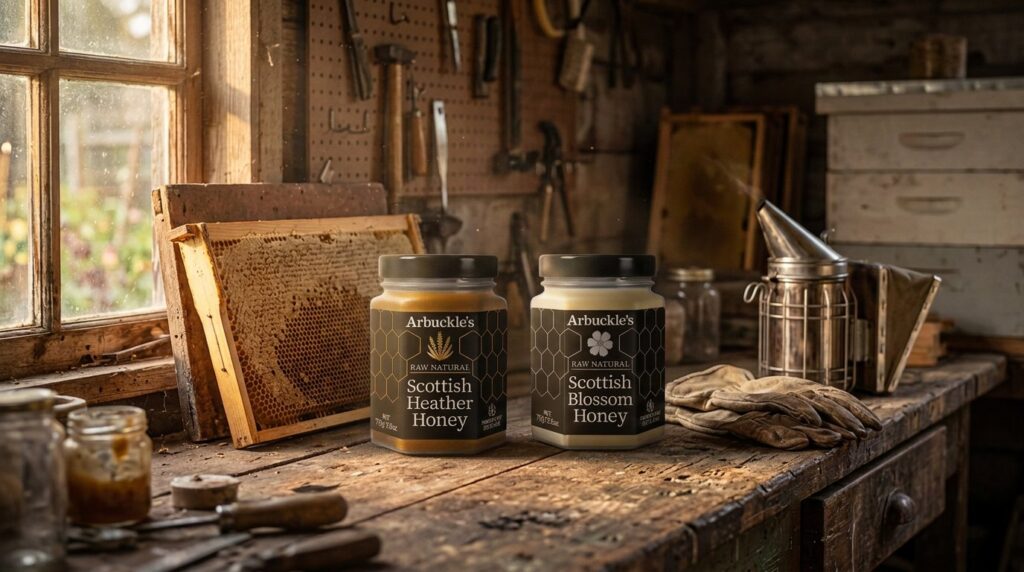
Our gift sets are named “Pure Scottish Heather Honey” and “Pure Scottish Blossom Honey”. “Pure” there means what it means on any jar: honey with nothing added. The words that tell you something are “Scottish”, “heather” and “blossom”. Our jars say “Scottish”, and under the rules it means the honey comes entirely from Scotland.
Honey label FAQs
What’s the difference between raw and pure honey?
“Pure” means nothing has been added, which the law already requires of all honey. “Raw” is the producer saying the honey has had minimal processing, including little or no heat. Neither word is defined in the honey regulations for England and Scotland. A jar can be both, but only “raw” says anything about how the honey was made.
Is raw honey the same as unfiltered honey?
Not necessarily. “Unfiltered” is about one step, filtering. “Raw” is a wider claim about processing, including heat. Since neither is legally defined, check how the producer describes the whole process.
What does unfiltered honey mean?
It’s the producer telling you the honey hasn’t been finely filtered. It may still have been strained or sieved to remove wax. Honey filtered enough to remove a significant amount of pollen must be sold as “filtered honey” in England and Scotland.
Is organic honey raw?
Not automatically. An organic label shows the honey was produced under certification, with a GB-ORG code on the label. It doesn’t, by itself, tell you whether the honey was heated or finely filtered.
Is “natural honey” a legal term?
No. “Natural” isn’t defined in the honey regulations for England and Scotland. Trading Standards guidance says words such as “natural” can be added to a honey label as long as they aren’t misleading.
Can babies have raw honey?
No. Honey isn’t suitable for babies under 12 months, raw or otherwise. The NHS advises not giving honey to children under 1, because it can occasionally contain bacteria that cause infant botulism.
Turn the jar round
Next time you’re choosing honey, read past the adjectives. Find the country of origin or the blend wording, check whether it’s sold as “honey” or “filtered honey”, look for a flower or place name, and if it says organic, look for the GB-ORG code. Then find out who made it and how. The friendly words are the producer’s pitch; the legal names are what the rules hold them to.
If you’d like honey we can explain step by step, from hive to jar, have a look at our Scottish honey range.