Set Honey vs Runny Honey: What’s the Difference?
Every spring we jar our blossom honey runny and golden, and a few weeks later customers ask us why it’s gone solid. Nothing has gone wrong. It’s set, which is exactly what raw honey is meant to do. Set honey and runny honey are the same honey in a different form, so here’s what the difference is, why it happens, and how to switch between them.
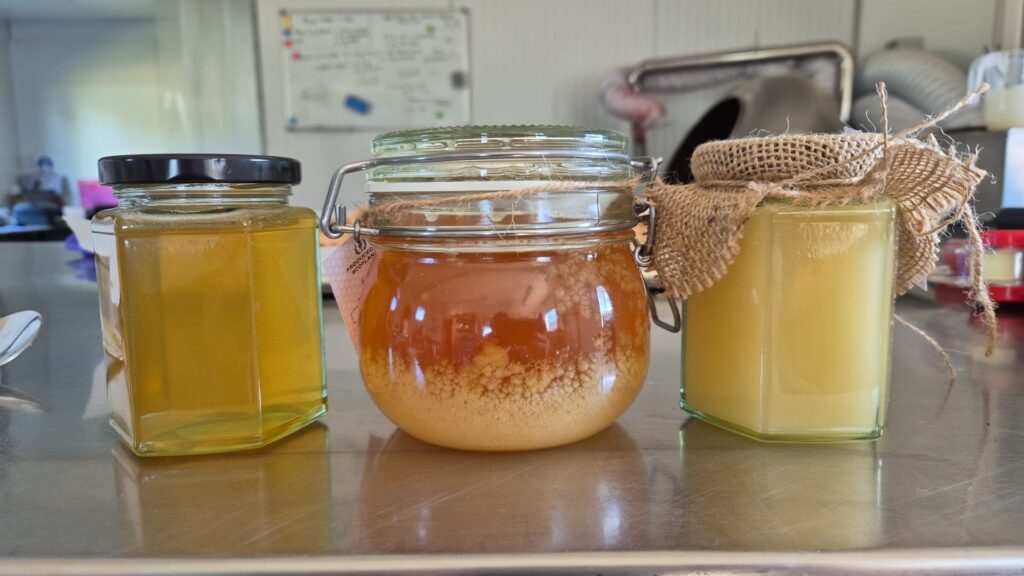
Here’s the whole journey in our honey room: runny on the left, starting to set in the middle, and fully set on the right.
What is set honey?
Set honey is honey that has crystallised. Instead of flowing, it’s thick and spreadable, from soft like butter to firm enough to stand a spoon in. It’s often paler and more opaque than runny honey, because tiny sugar crystals catch the light.
You’ll also see it called solid, thick or crystallised honey. It isn’t a different product, and nothing is added to make it. Leave most raw honey long enough and it will set on its own.
What is runny honey?
Runny honey, also sold as clear or liquid honey, is honey before it has crystallised. It pours, drizzles and stirs easily into drinks.
All honey starts out runny when it comes out of the comb. Some honeys stay runny for months, others set within weeks. Supermarket honey that stays clear for a very long time has often been warmed and finely filtered to keep it that way. Our post what is raw honey? explains that difference.
Why does honey set?
Honey is mostly two natural sugars, glucose and fructose, with a little water. There’s more sugar dissolved in it than the water can comfortably hold, so over time some of the glucose comes out as tiny crystals. Those crystals spread through the jar until the whole thing is set.
How quickly that happens depends on the flowers the bees visited. Honeys with more glucose set faster, and honeys with more fructose stay runny for longer. Cool temperatures speed it up too, which is why honey kept in the fridge sets quickly.
We’ll go into crystallisation in more detail in our next post, including why some jars go grainy and others stay smooth.
Set vs runny: which is better?
Neither. It’s the same honey, and setting doesn’t mean it has gone off. Choose by how you like to use it:
| Runny honey | Set honey | |
|---|---|---|
| Texture | Pours and drizzles | Thick and spreadable |
| Looks | Clear and glossy | Paler and opaque |
| Best for | Tea, porridge, yoghurt, dressings, baking | Toast, crumpets, scones, sandwiches |
| On toast | Can drip off the edges | Stays where you put it |
Many people keep a jar of each, or simply enjoy their honey runny at first and set later.
What is soft set honey?
Soft set honey, sometimes called creamed or whipped honey, is honey that has been encouraged to set in a controlled way. The beekeeper adds a little very finely set honey to runny honey and stirs it slowly over several days. The crystals that form are so small that the honey sets smooth and silky, like soft butter, instead of firm and grainy.
We don’t sell a plain soft set honey at the moment, although we do have our own creaming machine on the farm, so watch this space. Our fruit honeys come close: for our blossom honey with honeyberries, raspberries or strawberries, we cream the blossom honey until it’s smooth before blending in freeze-dried fruit from our own farm, so they’re smooth and spreadable.
Our honeys: runny, set or somewhere in between
Blossom honey is our spring honey, from the hives around our farm near Dundee. It’s runny when we jar it, starts to crystallise after two to three weeks, and then sets firm, pale and slightly grainy. We sell it just as it is, so depending on when your jar was filled, it may arrive runny, part set or fully set. All three are the same honey.
Heather honey is different again. It’s naturally so thick that it sits in the jar like a soft jelly, and it loosens when you stir it. Over time it can also crystallise slowly. Our guide to Scottish heather honey explains why it behaves this way.
Not sure which to choose? Our guide on how to choose a good honey matches each honey to how you’ll use it.
How to make set honey runny again
If you’d like your set honey runny, warm it gently:
- Take the lid off and stand the jar in a bowl of warm water, no hotter than 35°C. That’s comfortably warm to the touch, not hot.
- Leave it for 15 to 20 minutes, stirring now and then, until it’s runny. Top up the warm water if it cools.
- Put the lid back on and store it in the cupboard.
Don’t microwave it or stand it in boiling water. High heat changes the flavour of raw honey. Expect it to set again over the following weeks. That’s normal.
How to keep honey runny for longer
You can slow setting down, but you can’t stop raw honey setting for good:
- Keep it in a cupboard at room temperature, never in the fridge.
- Keep the lid on tightly.
- Use a clean, dry spoon, so no crumbs or water get into the jar.
Set honey FAQs
Is set honey still good to eat?
Yes. Setting is a natural change in texture. It doesn’t mean the honey has gone off.
Is set honey raw?
It can be. Raw honey usually sets on its own, so a set jar is often a sign the honey hasn’t been heavily processed. Our guide to what the words on a honey label really mean explains what “raw” tells you.
Is clear honey the same as runny honey?
Yes. In the UK, “clear honey” on a label means runny, liquid honey.
What’s the difference between set honey and soft set honey?
Set honey has crystallised on its own and can be firm or slightly grainy. Soft set honey has been stirred as it sets, so it’s smooth and creamy.
Can I cook with set honey?
Yes. It melts as soon as it’s warmed, so it works just as well in baking, porridge or a hot drink.
Can babies have set or runny honey?
No. The NHS advises that babies under 12 months shouldn’t be given any honey, whether it’s runny or set.