How Do Bees Make Honey? A Year in Our Hives
Every jar of honey starts as a drop of nectar in a flower, and it takes an extraordinary amount of teamwork to turn it into honey. We’ve kept bees since 2018, when we started with six hives on our farm near Dundee, and we look after over 500 hives across Scotland today. Our bees are Buckfast honey bees, a breed beekeepers value for being calm and hard-working. Here’s how bees make honey, why they make it at all, and what a year looks like in our hives.
How do bees make honey?
Honey is nectar that bees have collected, changed and dried. It happens in a few steps.
- Collecting nectar. Forager bees visit flowers and suck up the sugary nectar with their long tongues. They carry it home in a special stomach, called the honey stomach or crop, which is separate from the one they use to digest food.
- Passing it on. Back at the hive, the foragers pass the nectar to younger house bees, mouth to mouth. Along the way the bees add an enzyme that starts breaking the nectar’s sugar down into simpler sugars.
- Drying it out. Fresh nectar is mostly water. The house bees spread it into the wax cells of the honeycomb and fan it with their wings, so warm air flows over it and the water evaporates. Slowly, thin nectar becomes thick honey.
- Sealing it in. When the honey is ready, the bees cap each cell with a thin lid of fresh beeswax. Capped honey keeps for a very long time, which is exactly what the bees need.
It’s a lot of work for a little honey. A single worker bee makes only a tiny amount in her whole life, so every jar is the work of thousands of bees and many thousands of flower visits.
Why do bees make honey?
Bees make honey to feed the colony. Nectar is only available while flowers are blooming, but the colony has to eat all year round. Honey is their store of food for the cold months, when there’s nothing to forage and the bees cluster together in the hive to keep warm.
A strong colony makes more honey than it needs to get through the winter. That surplus is what beekeepers harvest, and it’s why looking after the bees comes first: a healthy colony with plenty of stores is the only way to get good honey.
A year in our hives
Spring: blossom and the first harvest
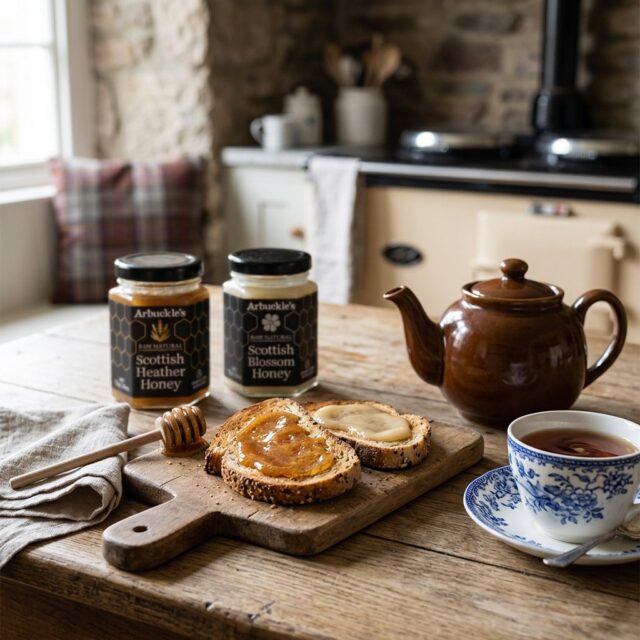
As the days lengthen, the queen lays more eggs and the colony grows quickly. Around our farm on the outskirts of Dundee, the bees forage on spring blossom and wildflowers, and that becomes our blossom honey, the first crop of the year, which we harvest in May. We spin it out of the comb in an extractor and coarse-sieve it. It’s pale, mild and floral.
Summer: up to the heather
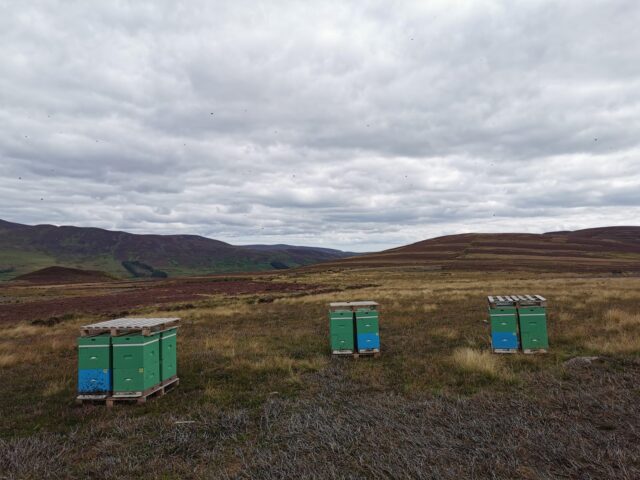
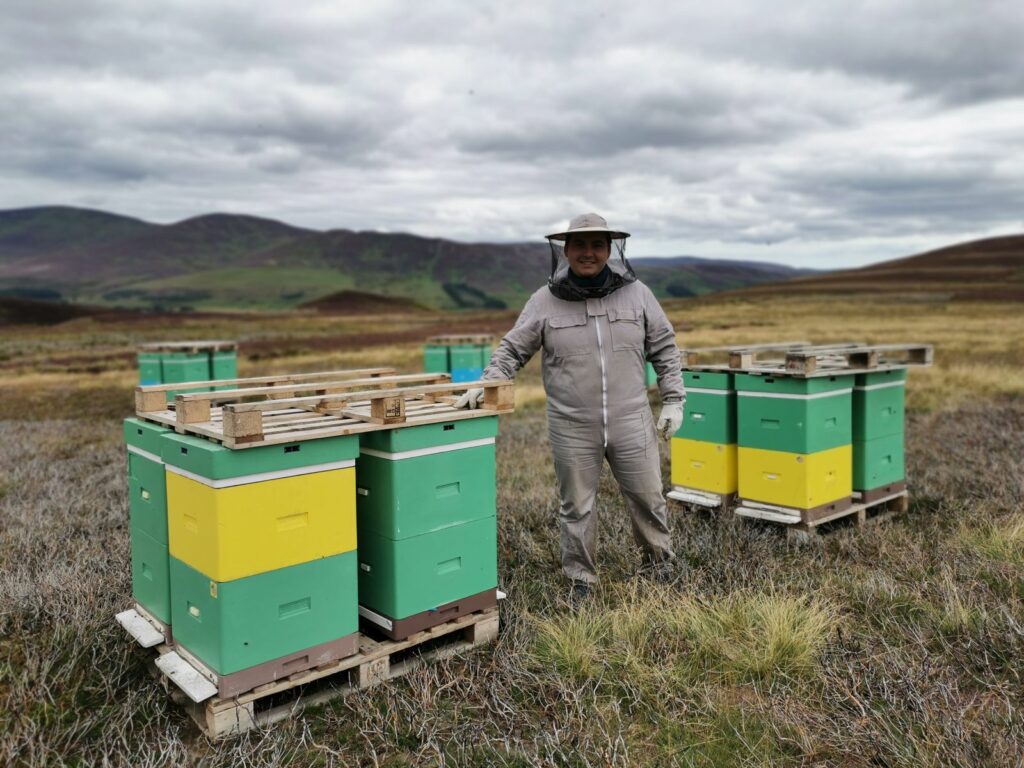
In July, we move all our hives up to the heather moors of Glen Clova and Glen Isla in the Angus Glens, and around Dunkeld in Perthshire. When the heather flowers in late summer, the moors turn purple and the bees get to work on it.
Late August: the heather harvest
We harvest the heather honey in late August. Heather honey is so thick, almost like a jelly, that it can’t be spun out of the comb, so we press it instead. It’s dark, smoky and rich, and it’s our last crop of the year. Our guide to Scottish heather honey tells the whole story.
Autumn and winter: rest
Once the harvest is in, the bees settle down for winter. We feed them to make sure every colony has enough food to last until spring, and they cluster together in the hive, keeping the queen warm, until the flowers come back. Winter is also when we cut our heather honeycomb by hand, a few pieces at a time.
From the hive to the jar
Everything we do after the harvest is about keeping the honey as the bees made it. Both our honeys are raw: spun or pressed from the comb, coarse-sieved to catch the wax, and never heat-treated or finely filtered. The only warmth they get is a gentle warming, below 40°C, to help the honey into the jar. Our post what is raw honey? explains more, and if you’d like the honey still in its comb, read our guide to raw honeycomb.
Because every jar comes from our own hives, our honey tastes of the places our bees forage. Our post on British single-origin honey explains why that matters.
Honey bee FAQs
Do bumble bees make honey?
Not the way honey bees do. Bumble bees store small amounts of nectar in little wax pots in their nests, just enough to feed the colony for a few days. A bumble bee colony doesn’t survive the winter (only the new queens do, hibernating on their own), so they never build up a store of honey that could be harvested.
Do wasps make honey?
The wasps we see in Britain don’t. A few wasp species in Central and South America store a honey-like food, but British wasps feed their young on insects and don’t store honey at all.
Why do bees make so much honey?
A colony needs a big store of food to get through a long winter with no flowers. In a good year, a strong colony makes more than it needs, and that surplus is what we harvest.
How long does it take bees to make honey?
It depends on the weather and the flowers. In a strong nectar flow, a colony can fill and cap frames of honey in a few weeks. In a cold or wet spell, the bees may make very little.
Can babies have honey?
No. The NHS advises that babies under 12 months shouldn’t be given any honey.