Why Does Honey Crystallise, and Is It Still OK?
We’re often asked whether their honey has gone off because it’s turned thick, cloudy or grainy. The answer is almost always no. Crystallising is one of the most natural things honey does, and raw honey does it more than most. Here’s why it happens, why it looks the way it does, and what to do with a jar that’s set.
Why does honey crystallise?
Honey is mostly two natural sugars, glucose and fructose, in a small amount of water. It holds far more sugar than that water would normally keep dissolved. Sooner or later, some of the glucose comes out of the liquid and forms tiny crystals. Each crystal gives the next one something to grow on, and over days or weeks they spread through the jar.
Three things decide how fast that happens:
- The flowers. Every honey has its own balance of glucose and fructose, depending on what the bees were feeding on. Honeys with more glucose set quickly. Honeys with more fructose can stay runny for months.
- Tiny particles. Raw honey still has specks of pollen and wax in it, because it hasn’t been finely filtered. Crystals form around them, so raw honey usually sets sooner than honey that’s been filtered until it’s perfectly clear.
- Temperature. Cool conditions speed it up. A jar in the fridge or a cold larder will set much faster than one in a kitchen cupboard.
Our post on set honey vs runny honey covers the basics of set honey and how to choose between the two.
Why our honey crystallises
Our blossom honey is made in spring from the blossom around our farm near Dundee. It’s runny when we jar it, starts to crystallise after two to three weeks, and then sets firm, pale and slightly grainy. That’s the flowers at work, and it’s why your jar might arrive runny, half set or fully set depending on when it was filled.
Our heather honey behaves differently. It’s naturally thick, like a soft jelly, and it crystallises much more slowly, usually over about two months. Our guide to Scottish heather honey explains why.
Supermarket honey that stays clear and runny for a long time has usually been warmed and finely filtered to slow crystallisation down. Ours is raw, so we let it do what honey naturally does. Our post what is raw honey? explains the difference.
Why does my honey look like that?
It’s gone grainy
The size of the crystals decides the texture. When honey sets slowly on its own, the crystals can grow large enough to feel slightly gritty on your tongue. When it sets quickly, or is stirred as it sets, the crystals stay tiny and the honey feels smooth. Grainy and smooth honey are the same honey.
It has white streaks on the glass
Pale, frosty streaks or patches on the inside of the jar are sometimes called “frosting”. As honey crystallises it shrinks slightly, and tiny pockets of air get trapped against the glass. It’s purely how it looks, and the honey is fine.
It’s set at the bottom and runny on top
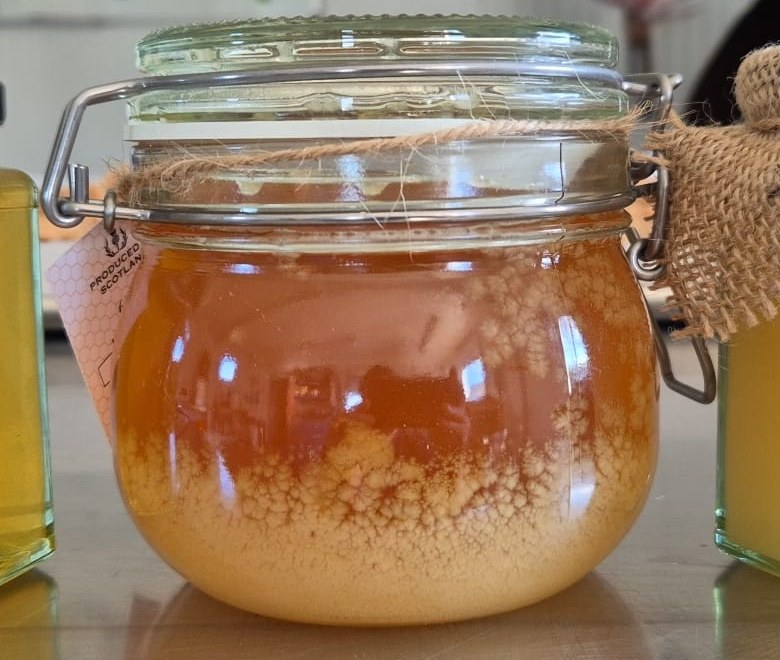
Honey often sets from the bottom of the jar up, so for a while you can see a layer of crystals under clearer honey, like the jar in our photo at the top of this post. Give it a stir, or wait, and the whole jar will usually even out as it finishes setting.
Is crystallised honey safe to eat?
Yes. Crystallised honey is still honey. Nothing has been added and nothing has gone wrong; only the texture has changed. You can eat it just as it is, or warm it gently to make it runny again.
Crystallising also doesn’t mean the honey is fake or has added sugar. Real honey crystallises.
Crystallised or gone off? How to tell
Honey keeps for a very long time when it’s sealed and stored at room temperature, but it can ferment if water gets in. Here’s how to tell the two apart:
- Crystallised honey is thick, cloudy or grainy, and smells and tastes like honey.
- Fermenting honey smells sour or a little like alcohol, may fizz or have a foamy layer on top, and can make the lid bulge.
If your honey smells or tastes sour, or has a foamy top, don’t eat it. Using a clean, dry spoon and keeping the lid on tightly stops water getting in. Our guide does honey go off? covers storage and shelf life in more detail.
What to do with crystallised honey
You don’t have to make it runny again. Set honey is lovely as it is:
- Spread it. Set honey stays put on hot toast, crumpets and scones instead of dripping off.
- Stir it into hot things. It melts straight into porridge, tea or hot milk.
- Bake with it. Warm it with the butter for flapjacks, or weigh it straight into a cake mix. It melts as it heats.
- Make a glaze. Warm a spoonful with mustard or soy sauce for roast vegetables or ham.
- Serve it with cheese. A spoonful of set honey sits neatly beside a strong cheese on a board.
How to make crystallised honey runny again
- Take the lid off and stand the jar in a bowl of warm water, no hotter than 35°C. That’s comfortably warm to the touch, not hot.
- Leave it for 15 to 20 minutes, stirring now and then. Top up the warm water as it cools. A large or very firm jar may take longer.
- Once it’s runny, put the lid back on and store it in the cupboard.
Don’t use boiling water or the microwave. High heat changes the flavour of raw honey. Expect it to set again over the following weeks. That’s normal, and you can warm it as often as you like.
How to stop honey crystallising
You can’t stop raw honey crystallising for good, but you can slow it down:
- Keep it at room temperature. A kitchen cupboard is ideal. Don’t keep honey in the fridge.
- Keep the lid on tightly, so the honey doesn’t take in moisture from the air.
- Use a clean, dry spoon, so crumbs and water don’t get into the jar.
- Freeze what you won’t use for a while. Honey barely changes in the freezer. Let it come back to room temperature before you open it.
Not sure which honey suits you? If you’d rather have honey that stays thick and spreadable, or one that’s best runny, our guide on how to choose a good honey can help.
Crystallised honey FAQs
Why does honey crystallize?
Crystallize is just the American spelling. Honey crystallises because it holds more natural sugar than its water can keep dissolved, so some of the glucose forms crystals over time.
Can you eat crystallised honey?
Yes. It’s the same honey with a different texture. Eat it as it is, or warm it gently to make it runny.
Does crystallised honey mean it’s pure?
Crystallising is what real honey naturally does, so it’s a reassuring sign, but it isn’t a test on its own. Some honeys stay runny for a long time naturally. Who made the honey and how it was made tell you more.
Why has my honey gone hard?
It has crystallised. Cool temperatures make it happen faster, so if the jar has been somewhere cold, move it to a cupboard at room temperature.
Can I put honey in the microwave to make it runny?
We wouldn’t. A microwave heats unevenly and can overheat raw honey, which changes its flavour. A bowl of warm water does the job gently.
Does honeycomb crystallise?
It can, over time, but honeycomb keeps very well. Our raw heather honeycomb is cut by hand, and kept at room temperature with the lid on, it’s still lovely to eat a year later.
Can babies have crystallised honey?
No. The NHS advises that babies under 12 months shouldn’t be given any honey, whether it’s runny or set.